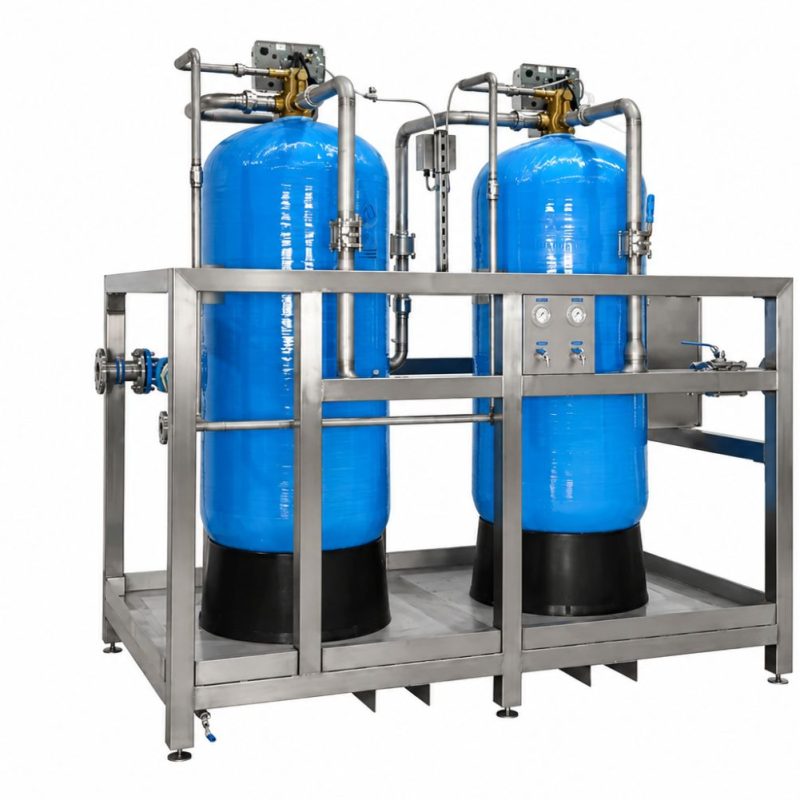
Water Softening Systems
Purpose and Operation
Water softening systems are designed to reduce the calcium and magnesium content of water. These minerals are responsible for water hardness and limescale formation, which can, over time, damage pipelines, heat exchangers, boilers, cooling towers, washing and rinsing systems, as well as other industrial equipment.
Water softening is achieved using ion exchange resin. During the process, calcium and magnesium ions are exchanged for sodium ions, producing softened water that significantly reduces the risk of limescale formation.
What Problems Does It Solve?
By using water softening systems, operational issues caused by hard water can be significantly reduced.
These may include, for example:
- limescale buildup in pipelines and fittings,
- reduced efficiency of heat exchangers and boilers,
- increased energy consumption,
- more frequent maintenance requirements,
- premature wear of industrial equipment,
- reduced operational reliability of process systems.
Properly treated, softened water helps extend the service life of machinery, fittings, and process systems while contributing to more reliable and cost-efficient operation.
Applications
Water softening is particularly important in industrial and process systems where limescale formation can lead to reduced energy efficiency, increased maintenance costs, or even production downtime.
Typical Applications:
Steam Boiler Plants
District Heating Plants
Cooling Circuits
Heat Exchangers
Industrial Laundries
Washing and Rinsing Processes
Hot Water Systems
Industrial Process Water Systems
Contact Us About Water Softening!
Pretreatment for Reverse Osmosis Systems
Water softening units can also be used as a pretreatment stage for reverse osmosis systems. Softened water reduces the risk of limescale buildup on the membranes, helping to extend the service life of reverse osmosis equipment while ensuring reliable and efficient operation.
This is particularly important in systems where membrane protection, operational reliability, and consistent water quality are critical requirements.
Customizable System Design
Our systems can be tailored to the specific water quality, required capacity, and process environment of each application. During the design process, we take into account the intended use, operating conditions, and the desired water quality to deliver a solution that meets your exact requirements.
The system design can be configured to define, among other things:
- required system capacity,
- water quality requirements,
- operating environment,
- control method,
- integration with pretreatment or post-treatment systems,
- compatibility with existing process systems.