CCRO Technology for Industrial Water Recovery
Less wastewater. More recovered water. Lower operating costs.
For industrial facilities, water management is no longer just a technological consideration—it is also a key factor affecting operating costs and regulatory compliance. Freshwater consumption, wastewater discharge, energy demand, and chemical usage all have a significant impact on operational costs and environmental performance.
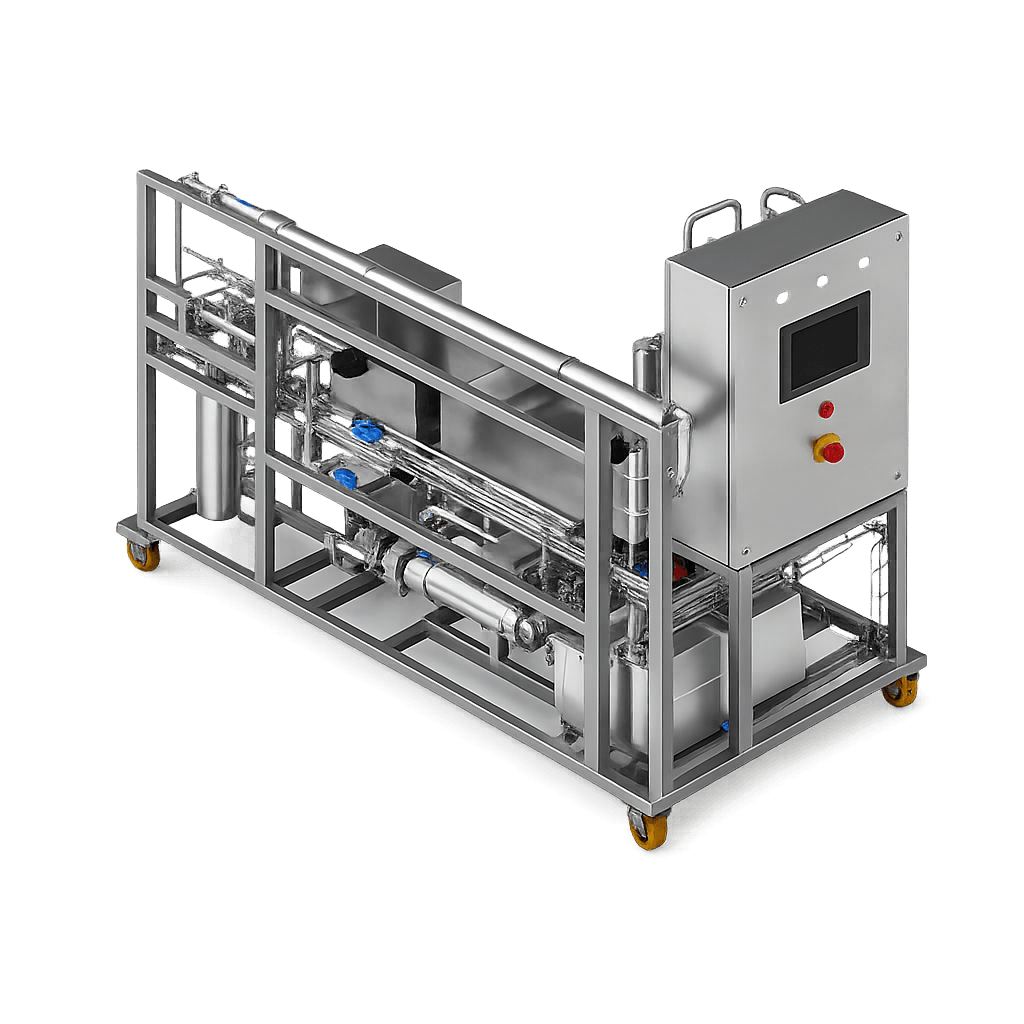
GYGV designs and manufactures industrial membrane-based water recovery systems that enable more efficient water reuse, reduce the volume of concentrated reject streams, and improve overall water management in industrial operations. In addition to conventional RO and NF technologies, we offer Closed Circuit Reverse Osmosis (CCRO) and Closed Circuit Nanofiltration (CCNF) systems for industrial applications where higher water recovery, greater operational flexibility, or lower concentrate volumes can provide measurable benefits.
What is CCRO?
CCRO (Concentrate Circulation Reverse Osmosis) is a closed-circuit reverse osmosis technology. Unlike conventional RO systems, CCRO operates in controlled cycles, where the concentrate is recirculated during a defined operating phase while the system continuously produces permeate, i.e. purified water.
This operating principle provides greater flexibility in system operation. Water recovery, crossflow velocity, operating pressure, and permeate quality can be optimized more effectively than with many conventional RO systems. As a result, CCRO is particularly well suited for applications where the performance of traditional membrane systems is limited by membrane fouling, scaling potential, fluctuating feed water quality, or excessive concentrate volumes.
Simply put, the goal of CCRO is to recover more usable water from industrial water streams while generating less concentrated reject stream.
What Are the Benefits of CCRO?
One of the key advantages of closed-circuit operation is that the system can be more precisely adapted to the specific application. This is particularly important in industrial environments where water composition, contaminant levels, temperature, pH, salinity, or organic load may vary over time.
In suitable applications, CCRO technology can significantly increase water recovery while reducing the volume of the concentrated reject stream. Actual performance depends on the composition of the feed water, the pretreatment process, membrane selection, and operating conditions. For this reason, GYGV determines the realistic water recovery potential through a detailed technical evaluation and, where necessary, pilot testing.
In suitable applications, CCRO technology can help:
- increase water recovery rates,
- reduce concentrate and wastewater volumes,
- reduce freshwater consumption,
- optimize energy and chemical consumption,
- improve membrane load management and reduce the risk of membrane fouling,
- improve the flexibility of industrial water management.
Typical Industrial Applications
CCRO and CCNF systems are particularly well suited for industrial water and wastewater treatment applications where the objective is not simply wastewater disposal, but the partial or substantial recovery and reuse of water.
Industrial Wastewater Reuse
With appropriate pretreatment and membrane-based polishing, many industrial wastewater streams can be evaluated for water reuse within industrial processes. This can reduce freshwater demand while lowering wastewater treatment and disposal costs.
Food and Beverage Process Water
The food and beverage industry often generates dilute process streams that contain valuable components or high levels of organic matter. These may include sugar-containing wash water, rinse water, syrup residues, fruit juice process streams, and fermentation by-products. In such applications, membrane technology can support water recovery, pre-concentration, or the reduction of organic load.
Treatment of CIP Solutions and Process Cleaning Water
For acidic or alkaline cleaning solutions, certain applications may allow for the partial recovery of water and valuable components, while contaminants are concentrated into a smaller reject stream. This can help reduce chemical consumption and minimize the wastewater treatment load.
Acidic and Alkaline Process Solutions
With appropriate material selection and a corrosion-resistant system design, the technology can also be evaluated for acidic and alkaline industrial process solutions. In such applications, careful assessment of water chemistry, membrane compatibility, corrosion resistance, and the cleaning strategy is essential to ensure reliable and efficient operation.
Contact Us About Water Recovery
Performance Verified Through Pilot Testing
The suitability of CCRO technology depends on the specific water stream and operating conditions of each application. Rather than offering a standard solution, GYGV develops a technology concept tailored to the requirements of each individual project.
The process typically consists of the following steps:
Technical evaluation
We assess the characteristics of the water stream, the operational objectives, current water and wastewater costs, and any technical constraints.
Technology proposal
Based on the water composition and operational requirements, we recommend the most suitable treatment approach, whether conventional RO/NF, CCRO, CCNF, or a combination of these technologies.
Pilot Testing, if Required
Pilot testing allows verification of water recovery, permeate quality, membrane fouling potential, and the overall economic feasibility under real operating conditions.
System Design and Manufacturing
Based on the results of the evaluation, a corrosion-resistant industrial system can be designed and manufactured to meet the specific requirements of the application.
Previous pilot studies have demonstrated high water recovery rates and significant TOC removal from sugar-containing beverage industry wastewater. In another application involving an acidic process solution, high phosphoric acid retention and promising reuse potential were confirmed. While these results demonstrate the capabilities of the technology, each application requires its own technical evaluation to determine the achievable performance.
GYGV: Application-Specific Industrial Water Recovery
GYGV’s strength lies in application-oriented system design. There is no single technology that is optimal for every application. In some cases, a conventional RO or NF system provides the best solution, while in others, CCRO or CCNF technology can deliver higher water recovery, greater operational flexibility, or improved economic performance.
The systems can be manufactured in corrosion-resistant designs with materials selected to suit the specific application, including Stainless Steel 304, 316, duplex stainless steel, and other application-specific materials.
Find Out What Can Be Recovered in Your Facility
If your facility has high freshwater consumption, significant wastewater treatment costs, excessive concentrate volumes, or you are looking to improve your water management and sustainability performance, it is worth evaluating whether CCRO technology is the right solution for your application.
Request a preliminary water recovery consultation, and let us identify the water reuse and cost-saving opportunities available in your facility.
Results depend on the specific application, water composition, and operating conditions. The actual water recovery and cost-saving potential can only be determined through a technical assessment and, where necessary, pilot testing.